Showing posts with label junior high age child. Show all posts

Tuesday, June 4, 2013

Free Parenting and Relationship Books!

Don't we all LOVE books?!? Richard and Linda Eyre are offering many of their books online for free... that's right, FREE! Isn't that wonderful??? They have a large collection of Parenting and Relationship books available.
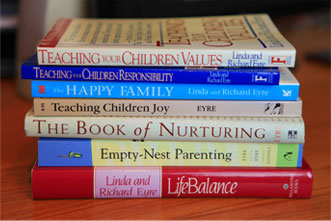
To view and read their books, you can go to www.eyresfreebooks.com
 
The article below was published in Desert News in February. It is all about the Eyre's and this wonderful offer. Enjoy!!

Authors Richard and Linda Eyre post best-selling books for free online
by Sarah Sanders Petersen

       Best-selling authors Richard and Linda Eyre have created a website that will house free digital copies of their books for anyone to read.
      "We're at a point in life now, in our 60s, where you start thinking a little different and our feeling is, 'Hey, let's get the books to as many people as possible,'" Richard Eyre said. "So much of the world can't afford to buy a book or maybe they live in a country where they can't get a book, but everybody pretty much now can get the Internet so you're not limited on who can go to a bookstore, or who has enough money."
       Eyre said that because they believe the ideas they offer in their books were never theirs, it only seems right to give them back to anyone who desires the help.
      "We didn't pay anything for the ideas we have," Eyre said. "In fact, we probably got them from other people. It makes sense to say, 'They were free to us, let's make them free to the people who want to read them.' We can do that because books have been really good to us. It just seems like the right thing to do to say, 'Thanks, that was good to us, now we want to give those books to anyone who wants them.'"
      The website, Eyresfreebooks.com, already contains 18 books that can be viewed online for free, including popular titles such as "Teaching Children Joy," "For the Manner of Men," "Life Balance" and more. Eyre explained that their goal is to add at least one book every few months until they have posted all of their published work online. Because of publishing contracts, they have not been able to list all of the books immediately.
      Another option will soon be available for Kindle users as well. The Eyres are currently working to get each of their books available to purchase for $2, rather than the higher current price listings.
Both options will be offered in order to stay up-to-date with the latest opportunities technology has created.
      "I'm an old school guy; I like books. I like to hold them in my hand, I like to feel them, but I've evolved," Eyre said. "Once I got hooked on the Kindle, I became sort of extreme on the other side. Instead of being a guy who drags his feet, I might as well get on the cutting edge — and to me the cutting edge is saying, 'Let's just make them free.'"
      "Teaching Children Joy" was the Eyre's first book published by Random House and truly opened the gate for their future publishing. "What Manner of Men" was written while Richard was serving as an LDS mission president in London. "Life Balance" was written 20 years ago, but Eyre said it is relevant to readers today.
      "It was written at a time when you didn't hear the word balance too much, but now balance is everything," he said.

{Sarah Sanders Petersen is an intern for Deseret News where she writes for Mormon Times and other feature articles. She is a communications major and editing minor from Brigham Young University.}

Monday, May 20, 2013

Last Day of School - Water Fight

Last Day of School – Water Fight

It’s finally here; the last day of school.  Kids are ready.  I’m ready.  Now we wait to begin the traditional celebration.   A family water fight. 

My husband and I pick just the right hiding spot in the front yard and await their arrival.  Our buckets are filled with water and balloons are ready to launch.  Flip top water bottles and filled water balloons hide in the yard ready for the kids to find.  In the distance we hear laughter and see the first of many excited children heading for home; arms full of treasures from the last day.  Friends become “watchmen” and signal when our children are within sight.  They watch with anticipation and begin offering cries of warning as we hoist our “weapons” for attack.

Our kids are home!  Eyes widen just as the first stream of cold water hits.  School treasures are safely tucked away in the corner of the yard and they’re off; screaming, yelling, and defenseless!  We laugh and declare victory until they find the hidden stash.  Balloons begin to fly and the water hose turns on.  The tide has turned.  Four against two—we are all soaked and the kids declare victory.  It’s summertime!

Each year the strategy of attack varies, but the end result is always the same.  As our kids have grown, so has their creativity and resourcefulness.  My personal favorite was when they recruited another family to join the fun. They made arrangements for a ride home on an alternate route and snuck into our backyard to attack us from behind.  Victory was all theirs!

How does your family welcome summer?  We’d love to hear.

Friday, March 29, 2013

Question/Answer - Bullying

I have a ten year old son who is using his large size to intimidate others, including me, his mother.  What can I do to stop this bullying behavior?

First, consider the following questions:
   1) Is there something provoking this bullying behavior?
   2) Is there a place this kid is being bullied? (school, on-line, sibling)
   3) How is this person being parented?  Is it in aggressive, angry fashion? Is it one parent or both?

Whatever the situation may be, when interacting with a child who is “bullying” it is important to:

  • Make sure that you provide a place that your child can be HEARD.  Many times a child uses his size, because it has been more effective than his/her words to gain access to attention.
  • Respond slow and low to this child--Keep your words AND tone slow and low so he will feel your calm and respectful.
  • Respond with enforceable statements-Tell child what you will do, not what he/she has to do or shouldn’t do.  
    • “I am happy to take you to your friends or to help you with your homework when I feel treated with respect AND I feel treated with respect when you use calm, respectful words and actions with me.”
    • Hold child accountable by using enforceable statements to follow through with a consequence when a child gets physical or uses size to intimidate. Be consistent.
  • Remove self from situation if you or your child is not calm AND only continue when it is calm.  MODEL THIS CONSISTENTLY!
    • When child approaches you aggressively, say something like: “Oh buddy…..  I am happy to talk to you when we can both be calm.” Then slowly leave the situation.  Resist the urge to get the last word in. Do this EVERY TIME aggressive behavior is shown (by anyone).
    • Model that bullying is not effective to get you to compromise or negotiate
    • Pay attention to triggers and step in before they escalate. Offer choices before the child becomes resistant. “Hey…. It looks like you guys are having a little too much fun. Do you want a 3 or 5 minute break?”
If the bullying is happening at school, support the school with whatever consequences they have set up, while being supportive of your child and teaching conflict resolution techniques when the going is good.  5 Steps to Guiding Children to Solve Their Own Problems (Click here for the 5 Steps.)

If you aren’t sure if you or your spouse is using your size and strength in a way that feels like bullying to your child, think about the way it may look from your child's perspective when you are angry. Consider your proximity, tone, contact, gestures, etc.   

One way to discover what it might be like for your child is to do role-play reversal.

  • Let the child be the parent and you be the child.  
  • State the situation (You just drew with Markers all over the walls; You are sitting watching a movie you shouldn’t when it is chore time; You refuse to pick up the mess they made or do their family job. You just got caught in a lie.)
  • Make it “playful” and give them permission to be real.
  • Be willing to listen as it may be painful.
  • Then have them act out the way they would like the conversation to go.  
  • Point out the differences in the role-plays.
  • Talk about what the difference between calm and respectful and aggressive and angry feel like and how it end up working out for them.  
-Learn and do a little better.

Wednesday, January 4, 2012

Allowance

With the last few years of financial hardship experienced in our economy, we have seen many families - young & not so young – struggle to handle the difficulties that come with being inexperienced and uneducated in life’s lessons of successful money management. As parents our job is to teach our children and offer them the opportunity to learn tools and skills that will help them to be resourceful, respectful and responsible in life. One of those tools should be financial management. When parents provide a home “economy” to practice using money tools and skills while they are still living at home, children are then able to better learn the value of money, how to budget, save and spend wisely. This helps them be better prepared for the real world.

1. How do I know my child is ready for an allowance?
Generally we recommend that allowances begin somewhere around the age of 3 or 4 years old. This is when you start a home “economy” so that children can learn how to manage money. We recommend giving children two dollars per month per year of life (i.e. a 5 year old would get $10 per month), paid on a weekly basis. Of course, parents with limited resources may need to modify the amount paid.

2. How do I explain the concept of allowance to my kids?
We recommend explaining that the reason they receive an allowance is because of the simple fact that we all benefit from the contributions that we make to the family. Some contributions exist in the form of jobs (like teaching children how to be ready for the grown-up world) or chores, our value system: like being responsible to tell the truth, trusting each other, being supportive and kind, etc. The result of our contributions are benefits such as having a place to live and food to eat; learning how to work hard, (how to cook & clean, be organized and follow through on a specific task given) and feel good about who we are. Allowance gives us money to manage - so that we learn how to budget and spend it wisely; and see its’ impact on other resources, including our time. Children also come to learn about the things that are privileges like going on vacations, driving a vehicle and having extra time available for special activities.

3. Should an allowance be tied to specific chores or behavior?
An allowance is designed to teach kids to manage money. Chores are designed to help a child learn how to contribute to the family. Allowance shouldn’t be tied to chores because we want our children to contribute in more ways that just chores. In regards to allowance being tied to behavior: allowance can be used if a child fails to do a chore and a parent needs to pitch in to get the chore done after the allotted time frame has expired. The parent can then charge the child for the chore and collect from the allowance.

4. Should a parent try to influence how their child spends allowance money or should they just let them “waste” it?
Teaching is the important concept in allowance! Therefore, modeling what we want to teach our kids is of great importance; that’s why starting from such a young age is so critical. Parents should try to teach kids how a finance economy works – what a 401K looks like, why you may donate to charity or a church, what saving for short term goal looks like, what long term saving for an investment is and what “spending money” is. Helping to set those up is really important –whether with a bank using a bank account or a piggy bank at home. Once they have their spending money” left over, parents should model how they spend their disposable income. This will help them learn by the parents’ example. They will also learn through family discussions on how to spend money. Once the teaching has occurred, we believe in allowing them to make the choice and decision to spend that money and learn from the consequences (good or bad). Parents should provide enough opportunities so that those learning consequences can come. When they are young, if they are willing, you can walk through the possible consequences; for example a poorly made toy that may break the day they buy it. When kids get older, they may or may not want to have the conversation – don’t force it.

5. What expenses should kids cover?
Once kids start getting an allowance, they should cover things like their own friends birthday presents, treats at the movies, and little store items that they may want to get – things for their own entertainment. As they get older and their needs increase, the allowance should also expand. One thing we highly recommend is “chores for hire” (chores that don’t need to be done weekly or maybe a one-time project) . If a child wants to increase their money to draw from, they can always earn from the “chores for hire” list. It’s important to remember that chores for hire are only available after their individual chores have been completed.

Tuesday, May 3, 2011

Question of the Week

“My kids leave their stuff ALL OVER the house!! How do I get them to clean up after themselves?”


1. Set the foundation before expectation! Teach when things are going good. Begin with collaboration or sharing the control by giving LOTS of choices. Once the child has successfully mastered the task, correction can be implemented as needed.
For example: “Today we are going to play ‘pick up’. Let’s practice for 10 minutes and then have a treat! Would you rather start in your room or in the play room? Do you want to do the balls or trucks first? Should they go in bins or lined up neatly? Which makes it easier for you to put away? Ok! Now let’s mess it up and practice putting it away again! Who can guess how fast we can get it done? 5 min or 7 min? Do you want to put some music on?


(With older kids who have already been taught, you may just skip this step).


2. As a parent, I must model what I want to see in my child. I won’t be tempted to remind or nag and can teach them in the present time. I may ask myself – “Am I putting my things away in a timely manner without whining”, OR do I say something like,“Hey guys… come and help me with this stuff… do you think I like cleaning up by myself?”


For example: If I want to model cleaning up and putting things away as we go, I may talk about it out loud: “’I’m just going to wash these pans up now so it won’t be a big problem later.” OR “I’m putting my shoes away so I don’t forget where they are tomorrow when I need them.”

3. If you see their stuff on the floor or elsewhere, do the following

- Remain calm, smile, and then give them the responsibility to take care of the problem.

Here’s an example:
Parent: “Do you want to take your shoes upstairs now or in 2 minutes?”
Child: “2 minutes”
Parent: “Great!”


Note: there is no choice given about taking them upstairs, just when it will happen.
If the shoes are still there after the 2 minutes, say something like this –
Parent: “I see your shoes are still here… Oh buddy… what did I ask you to do?”
Child: “But… mom….”
Parent: “What did I ask you to do?” (Go into ‘broken record’ mode here)
If the child refuses, say: “So are you saying you won’t take them up like you said you would? Bummer or how sad (empathetic one-liner)…” Then the parent takes the shoes and puts them in their collection/buy-back box. (I collect stuff and they can buy it back).


When they realize they need them, with a smile I can calmly say: “Oh…. I’m happy to let you have those back when you can pay me for the trouble I had to go to through to pick them up. And you can do that by ________ (doing an extra chore, or paying $$). Let me know which works for you.” (Remember, no sarcasm allowed!)

ShareThis